 Simpleswap
 fees - Tracing Costs and Comparing Swap Quotes
Last updated:Simpleswap fees are built into the crypto-to-crypto exchange rate rather than added as a separate percentage charge. The total cost also includes the network fee that the sending wallet pays for the deposit, while the quoted receive amount changes with the pair, liquidity, volatility, routing, and execution time.
Bottom line: A fair comparison holds the pair, amount, networks, rate type, and timing constant while counting the wallet’s separate deposit fee.
Cost inputs behind the receive amount
A crypto-to-crypto quote changes when the selected pair, amount, rate type, market conditions, available liquidity, or network conditions change. Simpleswap uses an all-in-one exchange rate, so it does not add a separate percentage trading fee above the quoted rate. The receive amount is therefore the useful starting number, not a published fee percentage.
- The trading pair governs available liquidity and routing.
- The amount can affect route availability, minimums, and fixed-rate limits.
- Volatility and execution time can move a floating-rate result.
- Network load changes blockchain charges for the deposit and payout.
- An eligible account discount reduces the embedded service fee, not blockchain fees.
These inputs interact. A pair with deep liquidity can still face an expensive deposit network, while a low network charge does not guarantee a strong exchange rate. Convert the total wallet outflow and final amount received to the same comparison unit before comparing them. This comparison includes the embedded service component, routing costs, and separate deposit charge.
Where does each charge go?
The quoted rate or receive amount reflects the service fee, liquidity, routing, and payout network costs, while the sending wallet pays the deposit network fee separately. Simpleswap does not expose every internal component as a separate line item, so the displayed output and the wallet’s network charge are the records a user can actually compare.
Costs inside the rate
The bundled rate accounts for the service fee, available liquidity, routing costs, market conditions, and estimated network costs used to deliver the output. Simpleswap and its selected liquidity provider handle those internal components. A loyalty discount, when available, applies to the service fee inside this pricing rather than creating a separate credit against network charges.
Network charges
Network charges are protocol-defined costs for processing blockchain transactions. Depending on the network, fees may go to miners or validators, be burned, or be split among protocol-defined destinations. Their treatment differs at the two ends of a swap.
Deposit transaction
The deposit transaction starts in the sending wallet. Its network fee is set by network conditions and wallet transaction requirements, not by Simpleswap. The wallet may require an additional balance for this charge. That expense sits outside the displayed exchange amount.
Payout transaction
The payout transaction sends the exchanged asset to the receiving address. For a fixed-rate exchange, the network fee for that payout is already included in the displayed receive amount. It is not an extra amount deducted after the fixed quote is honored. The deposit-side fee remains separate.
Reading a quote before funding
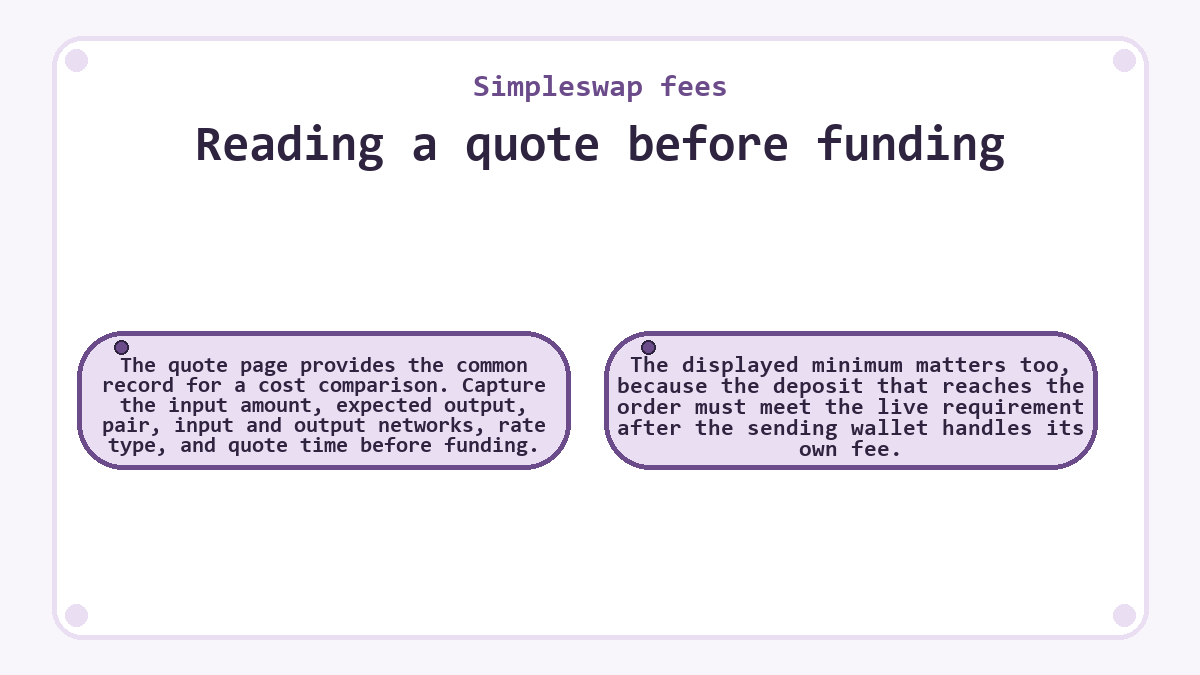
The quote page provides the common record for a cost comparison. Capture the input amount, expected output, pair, input and output networks, rate type, and quote time before funding. The displayed minimum matters too, because the deposit that reaches the order must meet the live requirement after the sending wallet handles its own fee.
The Exchange ID connects the quote with processing records, while transaction hashes show the deposit fee, sent amount, payout, and confirmation state on their respective blockchains. After completion, use the actual amount received for a floating rate, not its earlier estimate. For a fixed rate, confirm that the deposit met the lock conditions before treating the original output as binding.
How should fixed and floating quotes be compared?
Fixed and floating quotes should be compared as different allocations of price-movement risk. A fixed quote prioritizes a defined receive amount under its time condition. A floating quote provides an estimate that is recalculated during processing and can finish above or below its initial output.
Fixed-rate certainty
A fixed rate locks the displayed exchange rate for 20 minutes. The deposit also needs at least one blockchain confirmation within that window. If it arrives too late and the rate has changed, the order may fail, followed by a refund offer or an option to continue at a new rate.
Floating-rate exposure
A floating quote has no rate lock, so market price, liquidity, and the confirmation interval can change the output before execution. Its flexibility should not be mistaken for a cheaper guaranteed result. Compare its estimate with a fixed quote only when both use the same pair, amount, networks, and timestamp, then account for the value of certainty separately.
Effective cost without a posted percentage
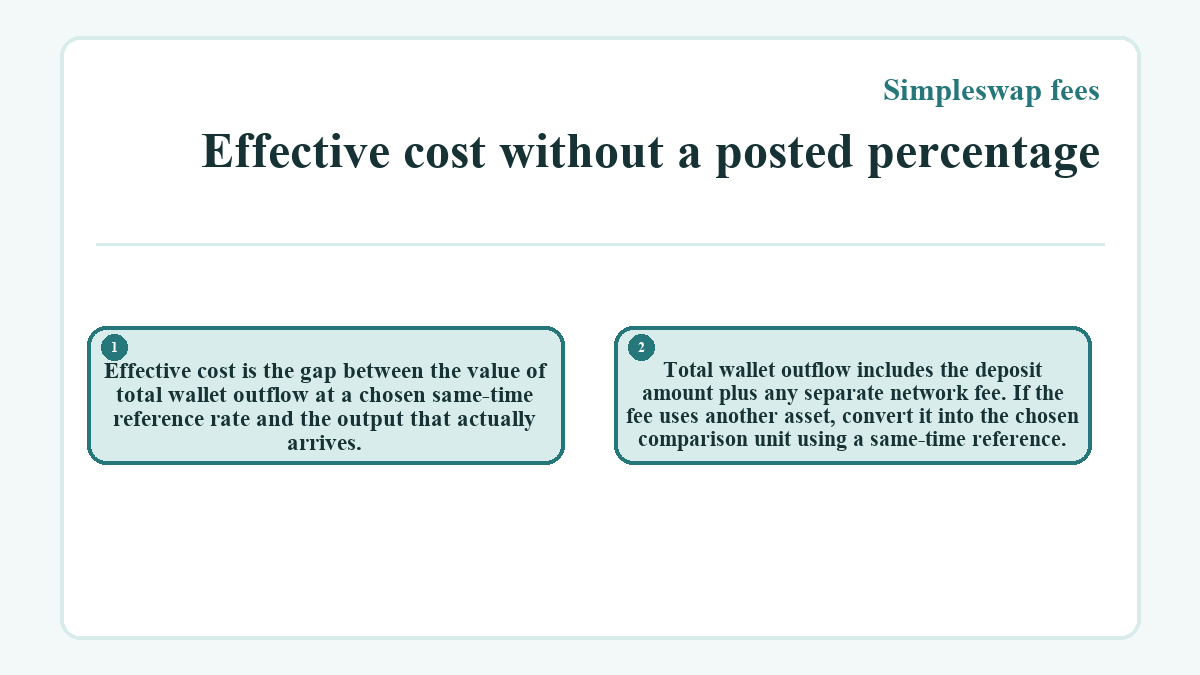
Effective cost is the gap between the value of total wallet outflow at a chosen same-time reference rate and the output that actually arrives. Total wallet outflow includes the deposit amount plus any separate network fee. If the fee uses another asset, convert it into the chosen comparison unit using a same-time reference.
An effective percentage can be expressed as that gap divided by the reference value of total outflow. This figure is a comparison tool, not a fee disclosed by Simpleswap. A reference rate may not be executable and may omit another venue’s trading, withdrawal, or network charges. Use the same reference method for every quote.
Direct quote comparisons are simpler. Hold the pair, amount, networks, rate type, and capture time constant, then compare expected receive amounts and separate wallet fees. A larger output is meaningful only when these inputs match.
What makes a quote comparison stale?
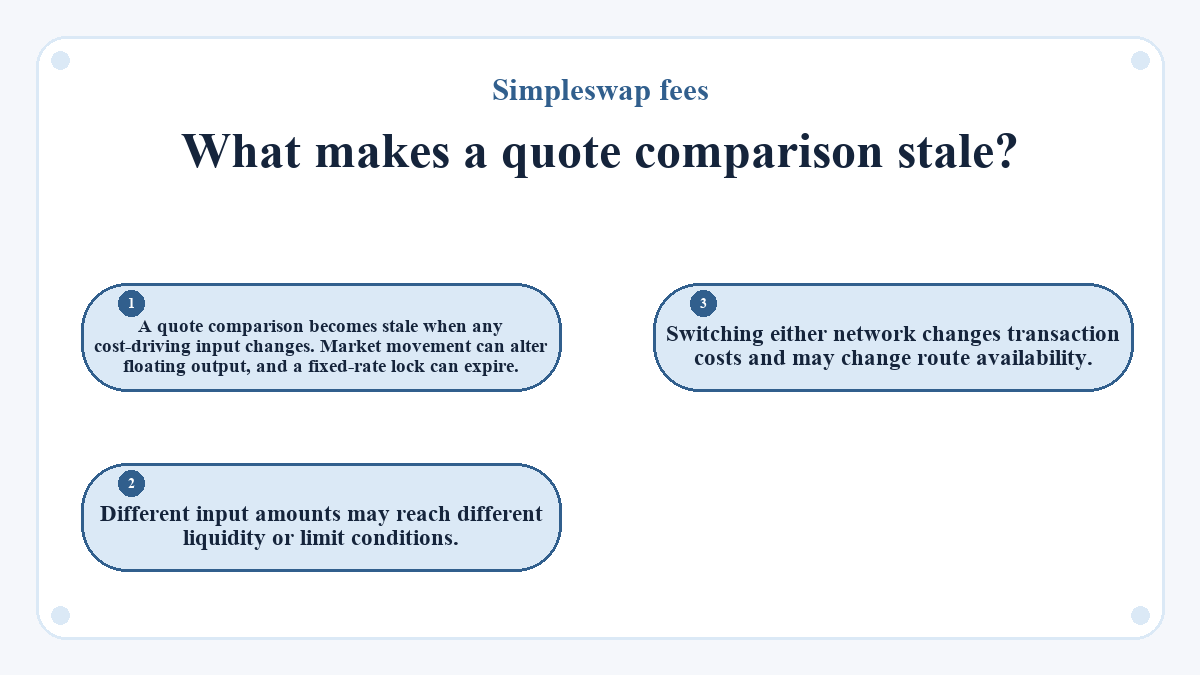
A quote comparison becomes stale when any cost-driving input changes. Market movement can alter floating output, and a fixed-rate lock can expire. Different input amounts may reach different liquidity or limit conditions. Switching either network changes transaction costs and may change route availability.
Account status can also alter the embedded service fee through an eligible discount. Wallet fee estimates move with network conditions. A quote created through an affiliate tool can also include a commission set by that affiliate, which changes the exchange rate. Refresh every candidate quote in a short interval before deciding. If one quote requires different networks or a different rate type, record that as a trade-off instead of forcing a single percentage.
A hypothetical cost trace
This worked calculation uses only hypothetical inputs: a deposit of 7.62 input-asset units, a wallet network fee of 0.022 input units, a fixed quote of 11.38 output units, and a same-time neutral reference of 11.54 output units for the 7.62-unit deposit. The route assumes the network fee uses the deposit asset.
The reference rate is 11.54 divided by 7.62, or about 1.5144 output units per input unit. The wallet fee is therefore worth about 0.033 output units at that reference. Total outflow has a reference value near 11.573 output units. Subtracting the fixed output of 11.38 leaves an effective cost of about 0.193 output units, or 1.67% of reference outflow.
The quote and transaction records should show an 11.38-unit payout and a separate on-chain deposit fee of 0.022 input units. The calculation no longer holds if the reference moves, the wallet fee changes, or the fixed-rate conditions are missed. A fee paid in another asset must be converted separately. The next decision is whether that measured cost justifies the fixed output or whether a refreshed floating estimate better fits the same task.
Before you start with Simpleswap fees
Does a customer account change the service fee?
Yes. A registered customer account can apply a loyalty discount to the service fee embedded in eligible quotes, depending on the account’s current level and reward setting. The discount does not reduce the blockchain’s network fee or a wallet’s separate deposit charge. Compare signed-in and unsigned quotes only when the pair, amount, networks, rate type, and capture time are identical.
Can the deposit fee use a different asset from the token being sent?
Yes. On some token networks, a wallet pays transaction fees in the network’s native asset even when it sends another token. The quoted deposit amount and the fee balance can therefore use different assets. Before signing, confirm which asset pays the fee and review the wallet’s estimate. Without enough of that asset, the wallet may not be able to broadcast the deposit.
Is the minimum exchange amount the same as the total wallet outflow?
No. The minimum exchange amount is the amount that must reach the deposit address for the selected order, while total wallet outflow can also include a separate deposit network fee. If the wallet deducts a fee from the amount sent, confirm that the on-chain transfer still meets the displayed minimum. The live minimum depends on the pair, liquidity, network fees, and current conditions.
Are fiat-to-crypto charges calculated like crypto-to-crypto fees?
No. Fiat-to-crypto offers use third-party payment providers, and their costs vary by payment method, currency, amount, crypto asset, region, and provider. Compare the final crypto amount, processing charges, exchange-rate spread, network-related costs, limits, and verification terms instead of applying the crypto-to-crypto all-in rate model.
What records explain a larger-than-expected cost difference?
Keep the timestamped quote, Exchange ID, deposit transaction hash, payout transaction hash, and wallet fee record. Together they show the promised or estimated output, the amount that reached the deposit address, the blockchain fee paid to send it, and the final payout. For a floating rate, compare against the executed output; for a fixed rate, also retain evidence that the confirmation met the lock window.